Looking to stay ahead of the latest gaming buzz while actually improving your in-game performance? You’re in the right place. This article breaks down the mechanics, multiplayer strategies, esports tactics, and smart progression hacks that serious players are using right now. Whether you’re grinding ranked, preparing for tournament play, or just trying to level up efficiently, you’ll find insights designed to give you a real competitive edge.
We analyze current meta shifts, patch updates, and high-level gameplay trends across competitive scenes to deliver strategies that work in live environments—not just in theory. Every tip is grounded in gameplay analysis, community-tested builds, and evolving competitive data.
Inside, you’ll discover how to optimize your loadouts, coordinate smarter in team modes, adapt to shifting metas, and maximize progression rewards without wasting time on ineffective strategies. If your goal is smarter play, faster improvement, and better results, this guide is built to help you get there.
Most failing reward systems break a simple psychological contract: effort must feel worth it.
Research on player motivation shows that variable reinforcement schedules (think loot drops in Diablo) increase engagement by up to 30% compared to fixed rewards (Frontiers in Psychology, 2019). Yet unpredictability without perceived fairness drives churn.
Common failure points:
- Rewards that lack visible progression
- Grind that outpaces meaningful upgrades
- Cosmetics with no status signaling
A 2023 Unity Gaming Report found 68% of players quit when progression feels stagnant. To maximize progression rewards, align challenge, clarity, and social prestige—because players chase meaning, not just coins.
The Psychology of a Perfect Reward Loop
To truly maximize your rewards from daily and weekly challenges, consider checking out the comprehensive guide in our ‘Instructions Pdf Hssgamestick‘ to streamline your approach and enhance your gameplay strategy.
A perfect reward loop isn’t about showering players with loot. It’s about balance.
First, consider Effort Justification—the idea that we value rewards more when we work for them (Aronson & Mills, 1959). Compare Scenario A: a legendary sword handed out in five minutes, versus Scenario B: the same sword earned after a tough but fair dungeon. The second feels legendary. Too easy? It’s disposable. Too hard? It’s demoralizing. The sweet spot is moderate, achievable effort (think early Dark Souls victories).
Next, Variable Reinforcement Schedules—unpredictable rewards delivered at irregular intervals (Skinner, 1953). Random rare drops can be thrilling. However, pure randomness vs. randomness with a “pity timer” is night and day. Without safeguards, players burn out. With a visible fail-safe, anticipation builds without resentment. Pro tip: show drop-rate transparency to build trust.
Then there’s Intrinsic vs. Extrinsic Motivation. A new ability that changes gameplay (intrinsic) deepens mastery. A cosmetic skin (extrinsic) signals status. One fuels competence; the other fuels identity. Strong systems blend both to maximize progression rewards.
Finally, anticipation ties it all together. Clear progress bars vs. hidden milestones? Visible progress wins. Teasing upcoming tiers keeps players engaged between unlocks (because waiting is easier when you can see the finish line).
Core Pillars of Modern Progression Systems
Modern progression systems aren’t just reward tracks—they’re behavioral architecture. When designed well, they guide players from casual curiosity to long-term mastery.
-
The Linear Path (Battle Passes & Leveling)
First, the foundation: a structured, tiered reward ladder. A dual-track battle pass—meaning a free reward path alongside a premium paid track—balances accessibility with monetization. Games like Fortnite popularized this model, showing that clear, incremental rewards every few levels significantly boost retention (SuperData, 2019). Importantly, each tier must feel tangible: currency drops, cosmetics, XP boosts. Critics argue battle passes create FOMO (fear of missing out), and that’s fair. However, when progression is transparent and time requirements are reasonable, players feel motivated—not manipulated. The benefit? Predictable engagement cycles and steady revenue. -
The Ritual Loop (Dailies, Weeklies & Contracts)
Next, habit formation. A ritual loop refers to recurring challenges that nudge players to log in consistently. However, “Play 3 Matches” feels like homework. In contrast, “Get 5 Headshots with a Sniper Rifle” promotes skill expression and experimentation. Well-designed contracts diversify gameplay and help maximize progression rewards without monotony. Pro tip: rotate objective categories weekly to prevent meta stagnation. -
The Long-Term Goal (Achievements & Mastery)
Finally, mastery systems reward dedication. Multi-tiered achievements—bronze to legendary—grant exclusive titles, animated emblems, or rare skins. These cosmetics signal status (think prestige badges in Call of Duty). While some argue cosmetics lack substance, visible mastery fuels competition and community respect. For deeper structural planning, see skill tree optimization building for long term growth.
Giving players real agency starts with choice-based rewards. Instead of handing every player the same loot, offer a curated selection: one of three weapon skins, two talent upgrades, or a cosmetic versus currency bundle. Psychologists call this the illusion of control, where even small decisions increase satisfaction and ownership (Iyengar & Lepper, 2000). In practice, players value the reward more because they picked it.
Scarcity and exclusivity amplify that effect. Time-limited events and seasonal battle passes transform digital items into status symbols. Think of rare skins in Fortnite or legacy mounts in MMOs; they signal dedication. Some argue scarcity manipulates players through FOMO. That risk is real. The fix?
- Keep windows predictable and transparent
- Make urgency feel exciting, not predatory
To strengthen long-term engagement, implement community-wide goals. Shared progression bars that unlock global bonuses create collective momentum. When everyone contributes, forums buzz and squads coordinate. Cooperation increases retention, especially in multiplayer ecosystems (Hamari et al., 2017). Pro tip: broadcast milestone progress in-client daily to sustain hype.
Finally, deploy a smart “comeback” mechanic. Returning players often feel overwhelmed by content creep. Offer accelerated XP, tailored quests, and gear catch-up bundles so they can maximize progression rewards without trivializing mastery. Critics say boosts cheapen effort. They don’t have to. Gate advantages behind skill-based challenges, ensuring returning players re-earn status rather than skip it. Balanced systems respect veterans while welcoming stragglers back into the action. Design with empathy, test relentlessly, and iterate based on player data and community feedback loops for lasting impact.
Common Progression Traps That Kill Engagement
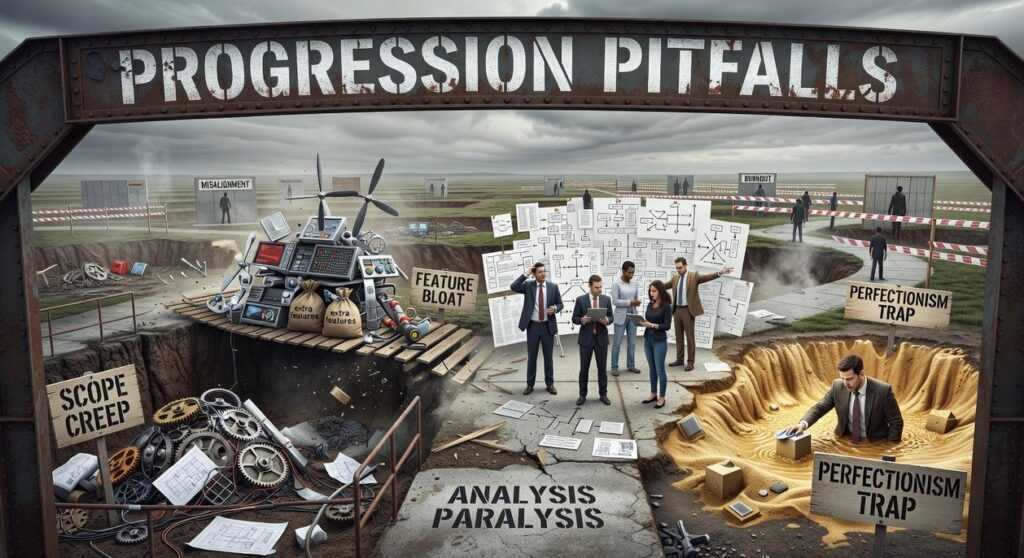
First, there’s the Grind Wall—when effort spikes so sharply that progress feels frozen. Players log in, see the mountain ahead, and log out (hello, backlog). Some argue difficulty builds loyalty. True—but only if effort scales with meaningful payoff.
Then comes Reward Inflation. If loot flows nonstop without sinks, nothing feels rare. It’s basic economics: oversupply kills value (see: Diablo III’s early auction house era).
| Trap | Player Reaction | Fix |
|---|---|---|
| Grind Wall | Burnout |
Smoother scaling |
| Reward Inflation | Apathy | Add sinks |
| Pay-to-Win | Frustration | Cosmetic monetization |
Finally, Pay-to-Win vs. Pay-for-Convenience matters. Sell power, and trust erodes fast. So what’s next? Audit pacing, rebalance sinks, and maximize progression rewards without breaking competitive integrity.
Building a System That Respects Your Players
Let’s be honest: nothing kills momentum faster than a progression system that feels like unpaid overtime. Players don’t log in to clock shifts—they log in to feel growth. So first, define your progression loop (the repeatable cycle of play, reward, and upgrade). If that loop feels grindy or unfair, they’ll bounce.
On the other hand, some designers argue friction builds commitment. Sure—but there’s a difference between challenge and chore. Instead, combine a clear linear path with daily rituals and long-term mastery goals. Give meaningful choices, exclusive rewards, and ways to maximize progression rewards. Audit pain points, fix friction, and watch retention rise.
Dominate the Game and Unlock Every Reward
You came here to figure out how to level up faster, win more consistently, and stop missing out on valuable in-game rewards. Now you understand the mechanics, the multiplayer strategies, and the tactical adjustments that separate casual players from true competitors.
The difference between grinding endlessly and progressing efficiently comes down to strategy. When you apply smarter loadout choices, map awareness, team coordination, and timing-based decision-making, you don’t just play more — you maximize progression rewards with every match.
If you’re tired of falling behind in ranked ladders, losing tight matchups, or wasting hours on inefficient builds, it’s time to change your approach. The right tactics turn frustration into momentum.
Stay ahead of the meta. Study the evolving strategies. Apply these insights in your next session and track the difference immediately.
Ready to climb faster and win smarter? Dive into the latest breakdowns, sharpen your tactics, and start dominating your next match today.